Insights—like
Darwin's understanding of the way evolution actually works, and Watson
and Crick's breakthrough discoveries about the structure of DNA-can
change the world. We also need insights into the everyday things that
frustrate and confuse us so that we can more effectively solve problems
and get things done. Yet we know very little about when, why, or how
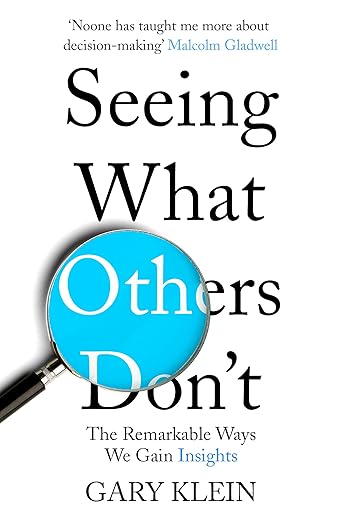
insights are formed—or what blocks them. In Seeing What Others Don't, renowned cognitive psychologist Gary Klein unravels the mystery.
Klein
is a keen observer of people in their natural settings—scientists,
businesspeople, firefighters, police officers, soldiers, family members,
friends, himself—and uses a marvelous variety of stories to illuminate
his research into what insights are and how they happen. What, for
example, enabled Harry Markopolos to put the finger on Bernie Madoff?
How did Dr. Michael Gottlieb make the connections between different
patients that allowed him to publish the first announcement of the AIDS
epidemic? What did Admiral Yamamoto see (and what did the Americans
miss) in a 1940 British attack on the Italian fleet that enabled him to
develop the strategy of attack at Pearl Harbor? How did a "smokejumper"
see that setting another fire would save his life, while those who
ignored his insight perished? How did Martin Chalfie come up with a
million-dollar idea (and a Nobel Prize) for a natural flashlight that
enabled researchers to look inside living organisms to watch biological
processes in action?
Klein also dissects impediments
to insight, such as when organizations claim to value employee
creativity and to encourage breakthroughs but in reality block
disruptive ideas and prioritize avoidance of mistakes. Or when
information technology systems are "dumb by design" and block potential
discoveries.
Both scientifically sophisticated and fun to listen to, Seeing What Others Don't shows that insight is not just a "eureka!" moment but a whole new way of understanding.





_1761911181.jpg)